Magnova
Magnova SuperAir || Premium 12L SFF mini-ITX PC Case
Magnova SuperAir || Premium 12L SFF mini-ITX PC Case
Couldn't load pickup availability
A 155 mm tower cooler. No riser cable. 11.9 litres.
Every other case this size makes you give up one of the three. The SuperAir doesn't.
The Magnova SuperAir is the only case at or under 12 litres that clears a 155 mm dual-tower air cooler with the graphics card mounted directly to the motherboard.
Cases that clear a 155 mm cooler are normally half again as large. Cases this small cap you at 55–77 mm, which means a low-profile cooler, a liquid AIO, or both. The SuperAir asks for neither.
- Clears a 155 mm dual-tower air cooler — the class of cooler you would normally fit in a mid-tower — in 11.9 litres.
- The graphics card mounts straight to the motherboard. No riser cable to buy, route or troubleshoot, and no PCIe signal loss.
- Takes a dual-slot card up to 272 mm, an SFX or SFX-L power supply, and up to four drives.
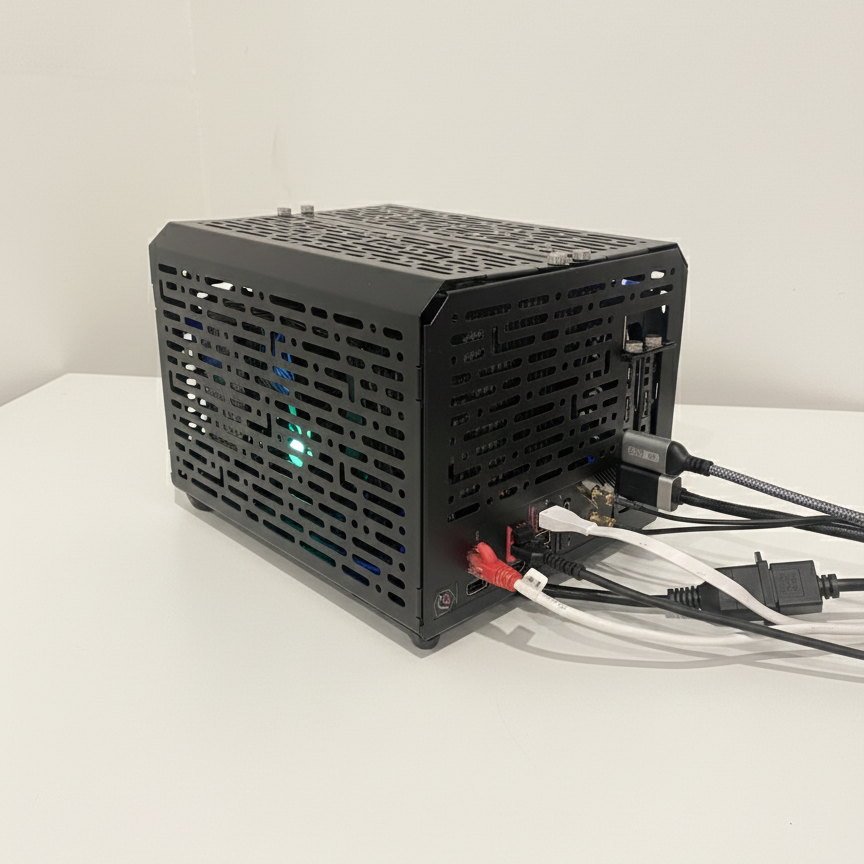
- 285 × 230 × 182 mm, 1.84 kg empty, 1 mm powder-coated mild steel. No case fans and no fan mounts — the perforated shell is what the tower cooler breathes through.
Fits a real cooler
155 mm clearance
Full dual-tower coolers like the Thermalright Peerless Assassin 120 SE fit with the panels on. No low-profile compromise, no pump, no tubing.
No riser cable
Direct PCIe mount
The card seats in the motherboard slot the way it would in any tower. One less part to buy, one less thing to go wrong, and no signal loss at PCIe 5.0.
Steel, not aluminium
1 mm powder-coated mild steel
Holds its geometry under the weight of a heavy tower cooler, resists dents through repeated transport, and shields high-power components packed close together.
Why no other case this size does this
Small cases get small by taking something away. Usually it is cooler height: the sandwich layout that makes a case compact puts the motherboard and the graphics card back to back, which leaves 55 to 77 mm for the CPU cooler and forces a riser cable to turn the card around. The SuperAir uses a different internal layout, so the cooler and the card both get full-size room.
| Magnova SuperAir | Fractal Terra | Lian Li × DAN A4-H2O | Cooler Master NR200P | |
|---|---|---|---|---|
| Max CPU air cooler | 155 mm | 48–77 mm | 55 mm | 155 mm |
| Riser cable | Not required | Required | Required | Optional |
| Volume | 11.9 L | 10.4 L | 11 L | 18.25 L |
| Max GPU | 272 mm, dual slot | 322 mm | 322 mm, triple slot | 330 mm |
| Case fans to buy | None | None included | None included | Two included |
Read the first three rows together. The NR200P clears the same cooler the SuperAir does, but it is 53% larger. The Terra and the A4-H2O are smaller, and both of them cap you at roughly a third of the cooler height and hand you a riser cable on the way out.
Where the SuperAir gives ground is graphics card length: 272 mm and dual slot, against 322–330 mm elsewhere. That is a real limit and we would rather you know it now than at the build. It is covered in full below.
Which CPU coolers fit the Magnova SuperAir?
- The SuperAir clears any CPU air cooler up to 155 mm tall.
- That covers the 155 mm dual-tower class — the coolers that normally require a mid-tower.
- It does not cover the 158–168 mm flagships. Those are listed below so you can check before you buy.
| CPU cooler | Height | Fits |
|---|---|---|
| Fits the SuperAir | ||
| Thermalright Peerless Assassin 120 SE ARGB | 155 mm | Yes |
| Thermalright Phantom Spirit 120 SE | 155 mm | Yes |
| DeepCool AK400 | 155 mm | Yes |
| Scythe Fuma 3 | 154.5 mm | Yes |
| Too tall — does not fit | ||
| Noctua NH-U12A | 158 mm | No |
| DeepCool AK620 | 160 mm | No |
| Noctua NH-D15 | 165 mm | No |
| be quiet! Dark Rock Pro 5 | 168 mm | No |
Building with a cooler that isn't listed? Check the manufacturer's published height. If it is 155 mm or shorter, it fits the SuperAir.
What the case costs isn't what the build costs
A case that caps you at 55 mm of cooler height has made a decision on your behalf: you are buying a liquid AIO, or you are accepting a low-profile cooler and the fan noise that comes with it. That decision has a price, and it is not on the case's product page.
| To cool the build, you also buy | Typical cost |
|---|---|
| SuperAir — a 155 mm tower air cooler | from about A$60 |
| 55 mm class case — a 240 mm liquid AIO | about A$150–220 |
| 55 mm class case — a low-profile air cooler instead | about A$60–120, at higher noise and lower headroom |
| SuperAir — case fans | none, no fan mounts by design |
| SuperAir — PCIe riser cable | none, the card mounts direct |
A A$60 air cooler with no pump, no tubing and no fittings is also one fewer component that can fail in a sealed 12-litre box, five years from now.
The shell exists so the cooler can breathe
A 155 mm dual-tower cooler moves more air than any case fan that would fit in 11.9 litres. So rather than design around case fans and then find room for a cooler, we did it the other way round: fit the largest cooler that will go in, then perforate every face so it can pull cool air straight through the shell. There are no case fans and no fan mounting points because at this cooler size they would be adding noise, not airflow.
-
The cooler is the case fan
Your CPU and GPU fans draw outside air directly across the components through the nearest perforated face, then exhaust upward. No second set of fans fighting them for the same air.
-
Perforated on every face
Hundreds of ventilation points create uninterrupted paths for rising hot air, so heat does not pool in a corner of a small enclosure.
-
Parallel, not sequential, airflow
The CPU, GPU and PSU each draw from their own face. Nothing sits downstream of anything else, so no component is cooled with air that has already absorbed another component's heat.


Measured thermal performance
| Test | Result |
|---|---|
| Processor | AMD Ryzen 7 7800X3D |
| Graphics card | ASUS Dual GeForce RTX 5060 Ti 16GB OC |
| CPU cooler | Thermalright Peerless Assassin 120 SE ARGB |
| Case fans | None |
| Ambient temperature | 23 °C |
| CPU temperature, 30 min full load | 73 °C |
| GPU temperature, 30 min full load | 76 °C |
| Noise at 1 m under load | 37 dBA |
The CPU holds 73 °C and the graphics card 76 °C under a sustained simultaneous load — 50 °C and 53 °C over ambient respectively, on a 120 W processor and a 180 W graphics card in a 12-litre enclosure with no case fans installed. For reference, 37 dBA at one metre sits between a quiet bedroom at roughly 30 dBA and a library at roughly 40 dBA.
These are our own numbers. Every figure above was measured in-house by Magnova, on the test system listed. We think that is worth saying plainly, because a manufacturer testing its own product is not the same as an independent review.
Review units are going to independent small-form-factor testers. When their results are published we will link them here — including any that disagree with ours.
Full component compatibility
Core Component Support
CPU Cooler
Air coolers up to 155 mm tall — the full dual-tower class. No radiator mounts; the SuperAir is an air-cooled case by design. Recommended: Thermalright Peerless Assassin 120 SE ARGB.
GPU Clearance
Direct-mounted dual-slot GPU up to 272 mm (10.71") long, 154 mm tall and 54 mm thick. No riser cable required. Suits dual axial fan designs such as the RTX 5060 Dual and WINDFORCE cards.
Power Supply
SFX and SFX-L units. Recommended: CORSAIR SF Series SF1000 (1000 W) for high-efficiency headroom.
Motherboard
Mini-ITX motherboards. Recommended: ASRock B650I Lightning WiFi (AM5, Ryzen 7000/9000).
Storage Flexibility & I/O
Storage Capacity (Up to 4 Drives)
- 2× 2.5" SATA SSD mounting points (for bulk storage/archives)
- Full M.2 NVMe support via motherboard slots (for OS/primary workloads)
No 3.5" bays — a 12-litre case is not the place for spinning disks.
Front I/O and Quality of Life Features
- 1× USB-C 3.2 Gen 2 (10 Gbps, formerly USB 3.1 Gen 2)
- 2× USB-A 3.0 ports
- Illuminated power button
- No front 3.5 mm audio jack — use your motherboard's rear audio or a USB headset
- Tool-less side panels for easy building
- Right-angled power cord extension & dust filter included
Which graphics cards fit the Magnova SuperAir?
The SuperAir is a 5060 to 5070-class chassis. It takes a direct-mounted dual-slot card up to 272 × 154 × 54 mm. Cards longer than 272 mm, or with a triple-slot bracket, do not fit — no exceptions and no workaround.
| Graphics card | Dimensions | Slots |
|---|---|---|
| Gigabyte RTX 5060 WINDFORCE OC 8G | 199 × 116 × 40 mm | 2 |
| ASUS Dual RTX 5060 OC 8G | 228 × 123 × 50 mm | 2.5 |
| ASUS Dual RTX 5060 Ti OC 16G | 229 × 120 × 50 mm | 2.5 |
| MSI RTX 5070 VENTUS 2X OC 12G | 236 × 126 × 50 mm | 2.5 |
Building with a card that isn't listed? Check the manufacturer's published length. If it is 272 mm or shorter with a dual-slot bracket, it fits the SuperAir.
Recommended build
The exact parts list Magnova used for the thermal test above. Every component fits the SuperAir with room to spare.
- CPU cooler — Thermalright Peerless Assassin 120 SE ARGB, 155 mm — a full dual-tower cooler, in a 12-litre case
- Processor — AMD Ryzen 7 7800X3D, 8-core / 16-thread, 120 W TDP
- Motherboard — ASRock B650I Lightning WiFi, mini-ITX, AM5
- Graphics card — ASUS Dual GeForce RTX 5060 Ti 16GB OC, 229 × 120 × 50 mm
- Power supply — CORSAIR SF1000, 1000 W SFX, 80 PLUS Platinum, fully modular
- Memory — CORSAIR Vengeance DDR5-6000 CL36, 32 GB (2 × 16 GB)
- Storage — Samsung 870 EVO 2 TB, 2.5" SATA, up to 560 MB/s read
Magnova SuperAir — full specifications
| Specification | Magnova SuperAir |
|---|---|
| Component compatibility | |
| Maximum CPU cooler height | 155 mm |
| GPU mounting | Direct mount to motherboard — no riser cable required |
| Maximum GPU length | 272 mm (10.71 in) |
| Maximum GPU height | 154 mm |
| Maximum GPU thickness | 54 mm (dual-slot mounting bracket) |
| Expansion slots | 2 |
| Motherboard | Mini-ITX |
| Power supply | SFX (125 × 63.5 × 100 mm) and SFX-L (125 × 63.5 × 130 mm) |
| Recommended PSU wattage | 600 W minimum for the recommended build; 750 W for headroom |
| Cooling type | Air cooling — passive perforated shell |
| Liquid AIO support | None — no radiator mounting points |
| Case fans included | None — not required |
| Case fan mounting points | None — fully passive design |
| Chassis | |
| Case type | Small form factor (SFF) mini-ITX desktop case |
| Internal volume | 11.9 litres (12 L class) |
| Dimensions | 285 mm (L) × 230 mm (W) × 182 mm (H) |
| Weight (empty) | 1.84 kg |
| Material | 1 mm mild steel, powder-coated |
| Colour | Matte Black |
| Side panels | Tool-less, removable |
| Dust filter | Included |
| Storage | |
| 2.5" SATA bays | 2 |
| 3.5" bays | None |
| M.2 NVMe | Via motherboard slots |
| Front I/O | |
| USB-C | 1 × USB-C 3.2 Gen 2 (10 Gbps) |
| USB-A | 2 × USB-A 3.0 |
| Audio jack | None |
| Power button | Illuminated |
| In the box | |
| Included accessories | Right-angled power cord extension, dust filter, mounting screws |
| Purchase & support | |
| Availability | Pre-order — Batch 2 ships November 2026 |
| Ships from | Sydney, Australia |
| Ships to | Worldwide — Australia plus 236 international destinations |
| Warranty | 24 months |
| Returns | 30 days from delivery date |
| Brand | Magnova |
Frequently asked questions
What size CPU cooler fits in the Magnova SuperAir?
The SuperAir clears a CPU air cooler up to 155 mm tall, which covers the full dual-tower class including the Thermalright Peerless Assassin 120 SE ARGB, the Phantom Spirit 120 SE, the DeepCool AK400 and the Scythe Fuma 3.
Coolers taller than 155 mm do not fit. That includes the Noctua NH-U12A (158 mm), the DeepCool AK620 (160 mm), the Noctua NH-D15 (165 mm) and the be quiet! Dark Rock Pro 5 (168 mm).
Do I need a riser cable for the Magnova SuperAir?
No. The graphics card mounts directly to the motherboard's PCIe slot, so there is no riser cable to buy, route or troubleshoot — and no PCIe signal loss.
How does the SuperAir compare to the Fractal Terra, Lian Li A4-H2O or Cooler Master NR200P?
The SuperAir is the only one of the four that combines a 155 mm CPU cooler with a direct-mounted graphics card at under 12 litres. The NR200P clears the same 155 mm cooler but is 18.25 litres, 53% larger. The Terra (10.4 L) and the A4-H2O (11 L) are both smaller than the SuperAir, and both use a sandwich layout that caps the CPU cooler at 48–77 mm and 55 mm respectively, and requires a PCIe riser cable.
Where those cases beat the SuperAir is graphics card support: the Terra and A4-H2O take cards up to 322 mm and the NR200P up to 330 mm, against the SuperAir's 272 mm dual-slot limit. The A4-H2O also supports a 240 mm liquid AIO, which the SuperAir does not.
Choose the SuperAir if you want a proper tower air cooler and no riser cable in roughly 12 litres. Choose the A4-H2O if you need liquid cooling or a triple-slot flagship card. Choose the NR200P if you are willing to trade 6 more litres for radiator support.
What size GPU fits in the Magnova SuperAir?
The SuperAir fits a dual-slot graphics card up to 272 mm long, 154 mm tall and 54 mm thick. Cards longer than 272 mm or with a triple-slot bracket do not fit.
Verified fits include the Gigabyte RTX 5060 WINDFORCE OC (199 mm), the ASUS Dual RTX 5060 OC (228 mm), the ASUS Dual RTX 5060 Ti OC (229 mm) and the MSI RTX 5070 VENTUS 2X OC (236 mm).
How big (small) is the Magnova SuperAir?
The SuperAir is 285 mm long, 230 mm wide and 182 mm tall, which is 11.9 litres of volume, and it weighs 1.84 kg empty. That puts it in the 12-litre class of small form factor cases — roughly the footprint of a shoebox.
Does the Magnova SuperAir need case fans?
No. The SuperAir runs entirely without case fans, and it has no fan mounting points by design. A 155 mm dual-tower cooler already moves more air than any fan that would fit in 11.9 litres, so the shell is fully perforated to let that cooler pull outside air straight through, rather than adding a second set of fans to compete with it.
Does the Magnova SuperAir support an AIO liquid cooler?
No. The SuperAir is designed for air cooling only — there are no radiator mounting points. It has clearance for CPU air coolers up to 155 mm tall, which is the point: you get dual-tower air cooling performance without buying an AIO, and without a pump to fail inside a sealed enclosure.
Does the Magnova SuperAir have a headphone jack?
No. Front I/O is one USB-C 3.2 Gen 2 port, two USB-A 3.0 ports and an illuminated power button. There is no front 3.5 mm audio jack, so use your motherboard's rear audio output or a USB headset.
How hot does the Magnova SuperAir run?
In Magnova's own testing, the CPU held 73 °C and the graphics card 76 °C after 30 minutes of sustained simultaneous full load at 23 °C ambient, with no case fans installed. Measured noise was 37 dBA at one metre, which sits between a quiet bedroom and a library.
The test system was a Ryzen 7 7800X3D with a Thermalright Peerless Assassin 120 SE ARGB cooler and an ASUS Dual RTX 5060 Ti 16GB OC — a 120 W processor and a 180 W graphics card in a 12-litre enclosure, cooled entirely by the perforated shell and the components' own fans. These figures are in-house, not independently verified; review units are with third-party testers and we will publish their results here when available.
What power supply does the Magnova SuperAir take?
The SuperAir takes standard SFX and SFX-L power supplies. A 1000 W SFX unit such as the CORSAIR SF1000 fits with headroom for a high-power CPU and GPU combination.
What wattage power supply do I need?
600 W is the minimum for the recommended build, and 750 W gives comfortable headroom. The ASUS Dual RTX 5060 Ti draws 180 W and NVIDIA specifies a 600 W system power supply for that card, while the Ryzen 7 7800X3D is rated at 120 W TDP with a 162 W package power ceiling.
Adding the motherboard, memory and drives, peak system draw for the recommended build lands near 400 W. The 1000 W CORSAIR SF1000 in our parts list is deliberate over-provisioning — it leaves room to move to a more demanding graphics card later without replacing the power supply, and it keeps the unit running in its quietest, most efficient load band. If you are building to budget, a quality 600–750 W SFX unit will run this configuration without issue.
How much storage can the Magnova SuperAir hold?
The SuperAir supports up to four drives: two 2.5-inch SATA SSD mounting points, plus the M.2 NVMe slots on your mini-ITX motherboard. There are no 3.5-inch hard drive bays.
When does the Magnova SuperAir ship?
The SuperAir is available to pre-order now. Batch 2 ships in November 2026.
Does Magnova ship internationally?
Yes. Magnova ships the SuperAir worldwide from Sydney, Australia, to 236 international destinations. Shipping within Australia is free and takes 2–8 business days.
International shipping is A$49 and takes 6–27 business days to Austria, Belgium, Canada, Czechia, Denmark, Finland, France, Germany, Hong Kong SAR, Ireland, Israel, Italy, Japan, Malaysia, the Netherlands, New Zealand, Norway, Poland, Portugal, Singapore, South Korea, Spain, Sweden, Switzerland, the United Arab Emirates, the United Kingdom and the United States. All other destinations are A$119 over the same 6–27 business day window.
What is the warranty and returns policy?
The Magnova SuperAir comes with a 24-month warranty, and returns are accepted within 30 days of the delivery date.
Designed by builders, for builders.
"We stopped asking how small we could make it, and started asking what we could refuse to take away."
Real-world tested with real components, and honest about where the limits are. If you want a proper air cooler and no riser cable in a case that still disappears under a desk, this is the one that does it.